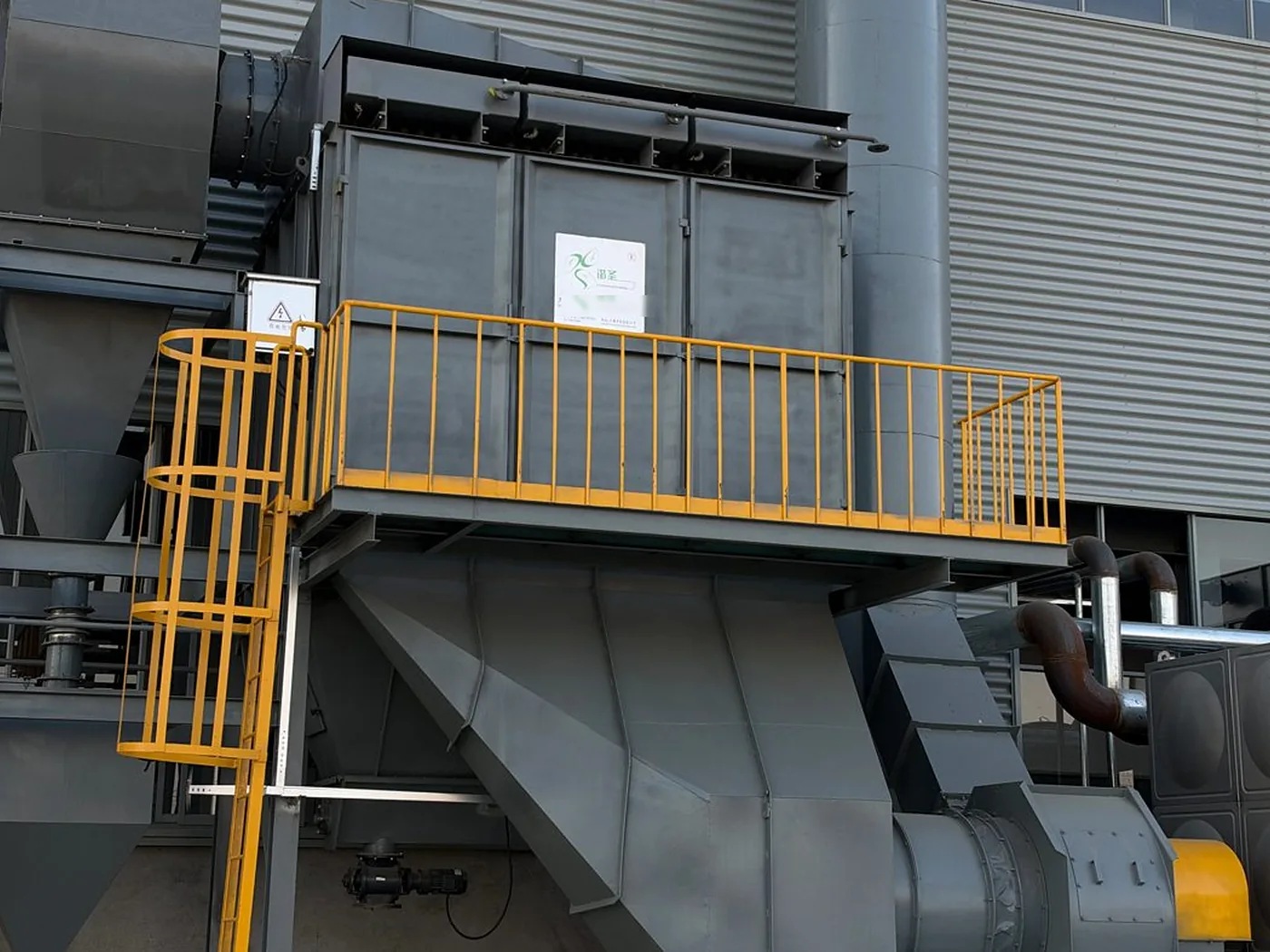
Why the unit arrives in pieces
A pulse-jet baghouse for a melting shop is wider and taller than a road vehicle. Shipping it as a completed shell would need a heavy-lift vessel, a wide-load permit at both ends, and a crane big enough to lift the whole box. Instead, the unit is broken into transport modules: shell rings, hopper sections, inlet transition, access doors, platform and handrail.
The trade is simple: more site work, less transport risk. Every module is trial-fitted at the workshop, marked against the erection drawing, and shipped with the bolts and gaskets for its joint. On site the work becomes assembly rather than fabrication.
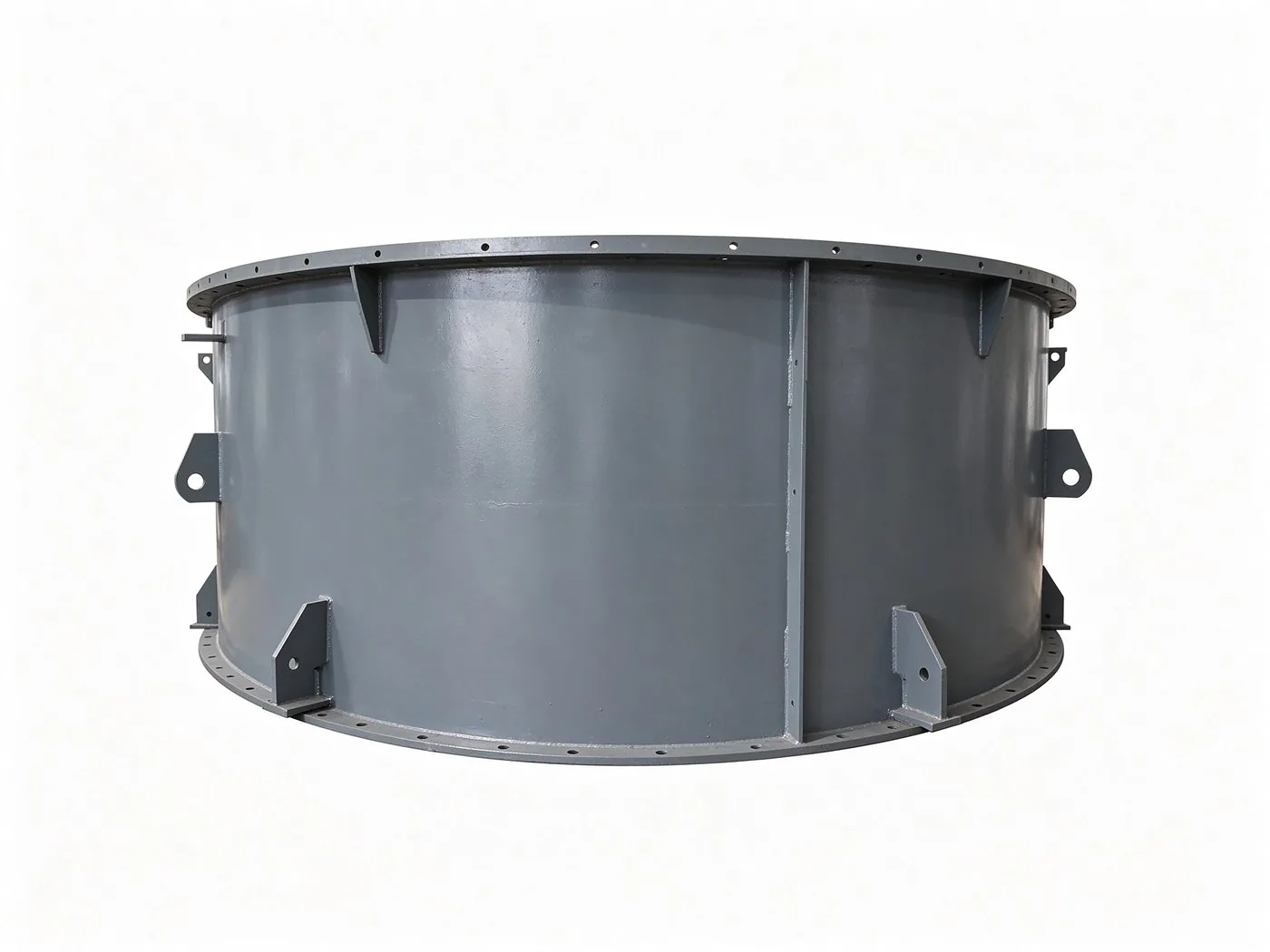
Shell ring at the workshop: flange, stiffeners and lifting lugs are part of the shipped module.
The assembly sequence
- Set the foundation and anchor points. Confirm the anchor bolt positions against the base drawing before placing the first column. A small offset at the base becomes a flange mismatch at the top.
- Erect the support steel and the hopper. The hopper modules go in first, because the shell rings sit on them. Check the cone angle and the discharge point before bolting down.
- Place the shell rings. Lift each ring by its four lifting lugs, seat the gasket, and bolt from the centre of the flange outward. Do not use the bolts to pull a misaligned ring into place.
- Fit the inlet transition and the duct connection. The inlet is a separate module on most units; we fit it after the lower rings so the duct can align without distorting the shell.
- Close the roof and fit the access doors. The crew fits doors with their gaskets and hinges, then assembles the walkway and handrail after the roof, not before.
- Install bags, cages and venturis. From the clean-air side, after the shell closes. Check the venturi seat and the cage length against the bag length.
- Fit dampers and actuators. Confirm the blade stroke, the actuator limit and the flange alignment before pressurising the duct.
- Leak test and commission. Check every flange, then leak-test and prove the cleaning sequence against the differential-pressure signal.
Delivery package: what should be on the packing list
| Package | Contents | Why it matters |
|---|---|---|
| Shell rings | Ring, flange gasket, bolts, lifting lugs | The crew cannot lift the ring safely without its lugs |
| Hopper modules | Cone section, discharge flange, stiffeners | We fix the cone angle and discharge point here |
| Inlet transition | Transition box, gasket, bolts | Duct alignment depends on this module |
| Platform and access | Walkway, handrail, ladder, door set | Erected after the roof, before bags |
| Loose items | Venturi, cages, damper, actuator, labels | Small parts decide the commissioning date |
The packing list must follow the drawing, not a generic parts list. If the marks on the crates do not match the erection drawing, the site team spends a day identifying parts instead of erecting them.
Three details that decide success
Flange flatness. A ring distorted in transport will not seal, no matter how much gasket you use. Check the flange with a straight edge before lifting; if it is out, correct it on the ground, not in the air.
Gasket and bolt sequence. Bolt from the centre outward, in two passes, to the torque on the drawing. A joint torqued from the ends traps the gasket and leaks at the middle.
Crane plan before the first lift. The crane position, the boom length, the lift radius and the rigging must be agreed before the modules arrive. The heaviest module is usually the inlet transition or a top ring, not the one the site team expects.
Before the crane arrives
- Anchor bolts set and grouted; base plates shimmed to level.
- Module marks checked against the erection drawing.
- Bolts, gaskets and torque values segregated by joint.
- Crane position and rigging agreed, with the lift plan signed.
- Access for the crane and the module trailers, including turning radius.
- Bags and cages kept under cover until the shell is closed.
What this means for a buyer
A modular baghouse is not a cheaper baghouse. It is a unit designed so that the transport limit, not the workshop limit, sets the module size. The buyer gets a shell that can be inspected from the inside before the roof goes on, and a site team that can follow a marked sequence instead of improvising.
If you are comparing offers, ask for the module list and the erection sequence, not just the equipment weight. The offer with a sequence is usually the one that has already thought about your crane.
Related reading: pulse-jet baghouse specification, Anhui foundry fume project, and shipping steel plant equipment in knock-down condition.