Overview
Vacuum and high-capacity induction melting furnaces present a capture challenge: fume generation is intense but intermittent, and the furnace area must remain accessible for overhead cranes during charging and tapping. A mobile extraction hood solves this by moving into position during melting and retracting when furnace access is needed, delivering high capture efficiency without disrupting production.
The hood travels on overhead or floor rails and connects to a central duct via a flexible, heat-resistant joint. Positioning can be operator-controlled via pendant or fully automated through furnace cycle signals.
Design & Operation
- Canopy Hood: A stainless steel rectangular or conical canopy positioned directly above the furnace mouth, sized to cover the full fume plume.
- Rail System: Heavy-duty linear rails mounted on the furnace structure or overhead steelwork, with travel stroke matched to furnace layout.
- Drive Mechanism: Gear motor with variable speed travel, limit switches at both ends, and optional encoder positioning.
- Flexible Connection: A high-temperature fabric expansion joint or sliding duct connects the moving hood to the fixed ductwork, maintaining a sealed path.
- Control Integration: Hood position interlocks with furnace cycle — extends when melting starts, retracts on charging/tapping signal.
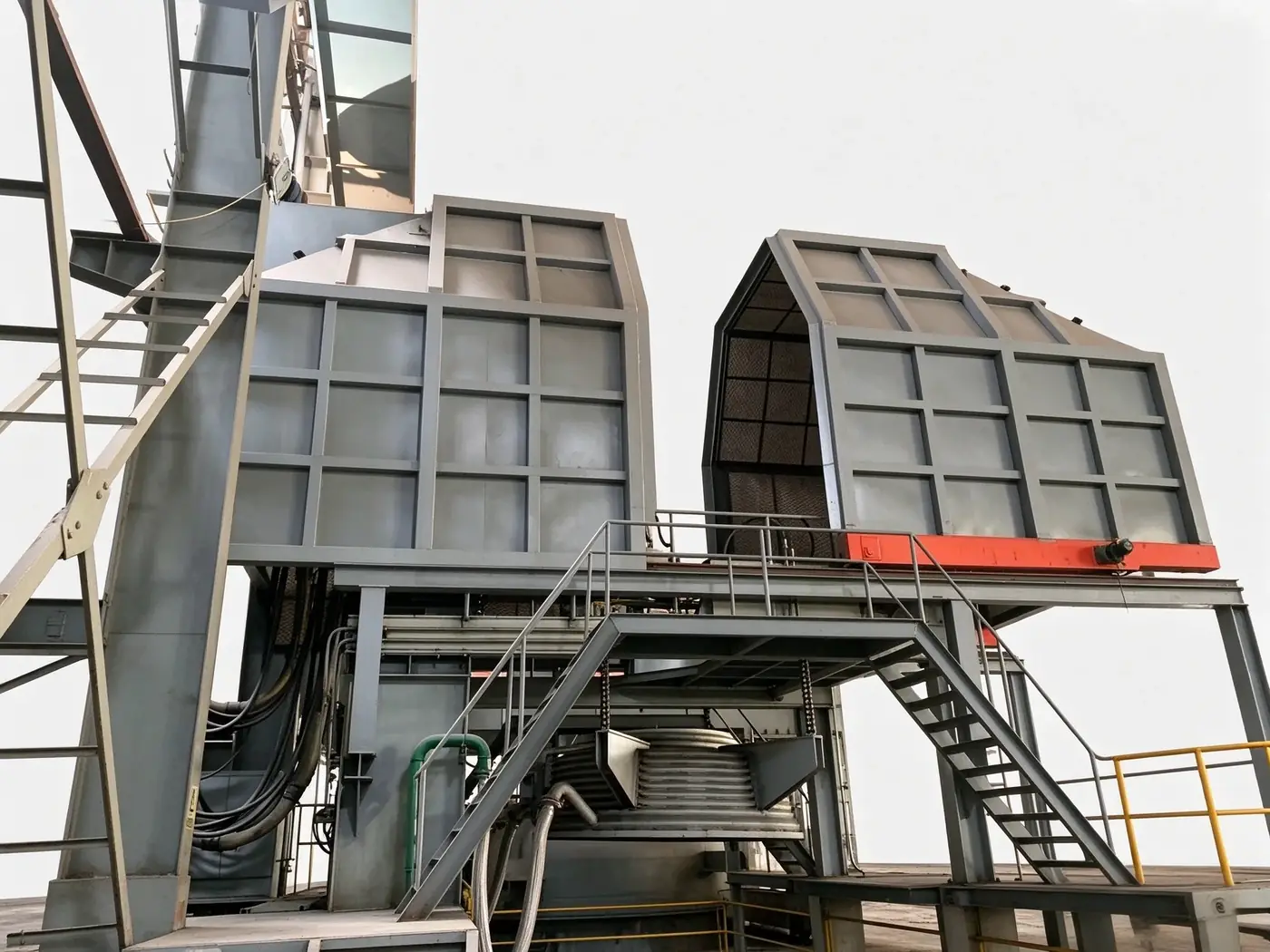
Twin-Hood Arrangement on a Furnace Platform
Where a melting shop works one furnace from two positions — charging on one side, tapping on the other — two hoods are mounted side by side on the same platform, each with its own travel and its own interlock. The hood over the working position stays down and captures; the other parks clear so the crane and the ladle have room.
Each hood runs on a geared drive with a screw or chain, and the two are set so they cannot collide when both move. Limit switches, guard rails and warning signage belong to the same package, because a moving hood over a furnace mouth is a lifting hazard as well as an extraction device. When the drive fails, the manual emergency mode lets the hood be parked before repair.
The photograph here is an installation reference from a melting shop platform: twin hoods, guard rails and the furnace body between them. Client details are not published.
Key Features
- Unobstructed crane access: The hood retracts fully clear of the furnace opening, allowing unimpeded charging and tapping operations.
- Capture at the lip: The canopy is parked close to the fume source and follows the melt cycle, so the plume is caught before it disperses across the platform.
- Heat-resistant construction: 304/316 stainless steel canopy with optional internal water cooling where radiant heat at the hood runs high.
- Automated positioning: Integration with the furnace PLC moves the hood with the melt cycle, so capture is active when the furnace is open.
- Low maintenance: Sealed rail bearings, stainless steel fasteners and quick-release flexible joints keep downtime short in a hot, dusty environment.
What We Need From You
Furnace mouth dimensions, platform layout, crane envelope, melt cycle, gas temperature at the hood, and where the existing duct can run.
Precision We Design To
- Travel: stroke fixed by the furnace mouth and the crane path, not by a catalogue number.
- Capture: canopy airflow sized to the plume from your melt rate and the distance it must hold.
- Interlock: limit switches and furnace signals wired so the hood cannot move into a charging crane and the pulse cannot fire while the hood is away.
How It Is Verified
Arrangement drawing with travel, duct route and rail position approved before fabrication; interlock and emergency-park function tested on site; dust and fume checked at the platform after commissioning.
Travel, canopy size and airflow are fixed on the approved drawing for your furnace, not published as a range.